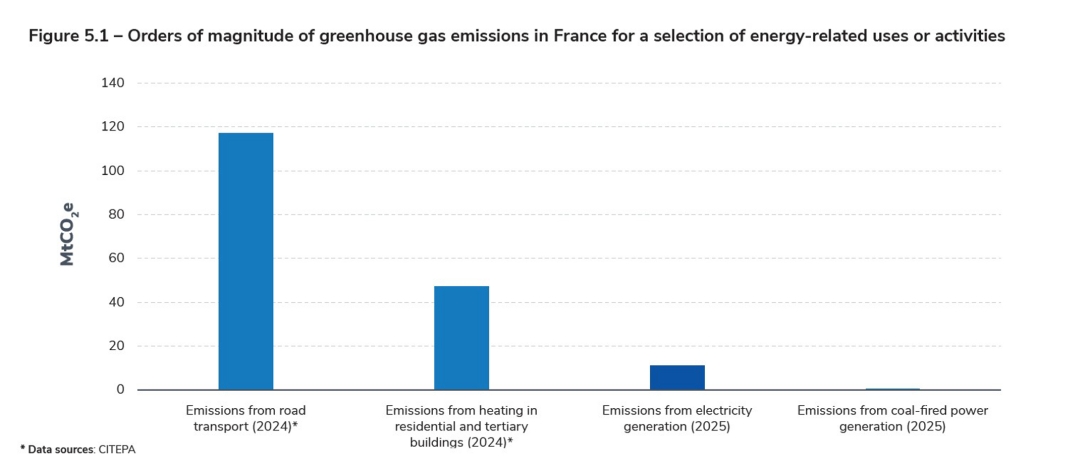
The carbon content of French electricity generation is one of the lowest in Europe, representing leverage for decarbonising the country's energy consumption
In France, electricity production is already almost all low-carbon, so the volume of emissions is low compared with other sectors of the economy and with electricity generation in neighbouring countries.
On the other hand, France's energy consumption (across all energy sources) still relies heavily on imported fossil fuels, at almost 60%. This highlights the value of accelerating electrification based on an electricity mix that has already been largely decarbonised (see the Electrification chapter).
For the third year running, direct emissions from French electricity generation continued to fall in 2025, reaching an all-time low since 1945 of 10.9 MtCO2e. This level is comparable to, but slightly lower than, the 2024 figure (11.7 MtCO2e).
In terms of carbon intensity, i.e. the quantity of emissions per quantity of energy produced, French electricity is among the least carbon-intensive in Europe, with 19.6 gCO2e per kWh generated in 2025, well ahead of most other countries; the average in the European Union (plus Switzerland, Norway and the United Kingdom) is 175 gCO2e per kWh. Despite relatively high per capita electricity consumption in relation to comparable European countries1, electricity generation represents only a small proportion of the national carbon footprint: less than 5% in France, compared with around 20% in Germany, Spain and the European Union as a whole2 3.
Fossil-fired electricity generation was used particularly infrequently in 2025, which explains these unusually low levels of emissions (see the Generation chapter). In particular, the most emissions-intensive fossil fuels, coal and oil, were scarcely used at all. Gas-fired generation, which currently relies mainly on fossil gas, emits slightly smaller quantities of greenhouse gases than coal and oil. It currently accounts for the bulk of fossil-fired electricity generation in France, and also reached an all-time low in 2025.
With French electricity generation now almost entirely low-carbon, the main challenge for France is to replace fossil fuels with low-carbon electricity on a large scale in sectors other than electricity generation (such as transport, buildings and industry). This will mean an increase in electricity consumption in the medium to long term.
The decarbonisation of the electricity mix has been achieved gradually and successfully over the last few decades, with the development and maintenance of a large base of low-carbon hydroelectric and nuclear generation, followed by the closure of the most polluting power plants (coal and oil-fired) and the development of solar and wind generation. For the French energy system as a whole, two goals must now be pursued at the same time:
- from the consumption viewpoint , making the massive switch from fossil energy vectors to electricity a reality across the economy (transport, industry, tertiary and residential buildings (see the Electrification chapter) and in new energy uses (data centres, electrolysers);
- from the electricity generation viewpoint, establishing a development pathway for low-carbon generation resources that is consistent with the target pathway for decarbonising the economy.
These issues are examined and developed in detail in the 2025–2035 Generation Adequacy Report published by RTE at the end of 2025.