BE 2025 - Émissions [EN]
Sections
Section externalisée
Menu tertiaire
Paragraphes de la section
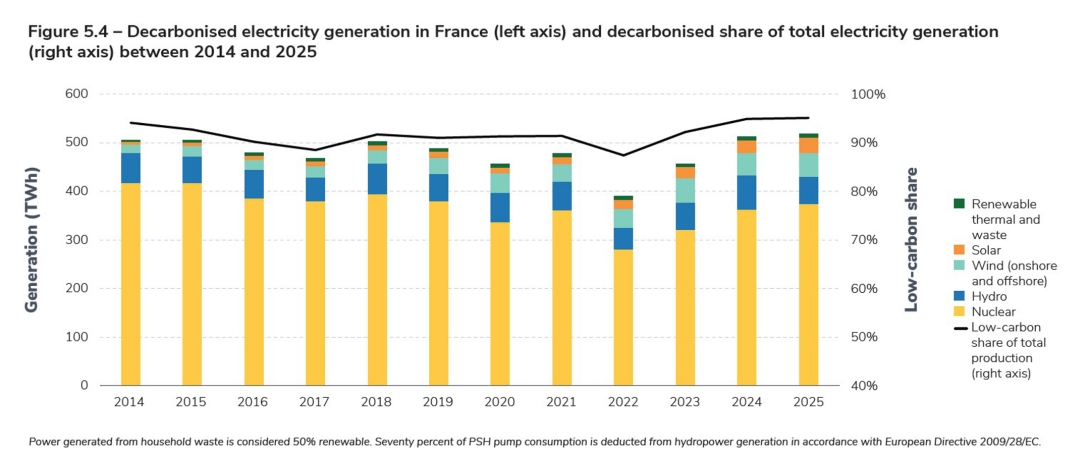
The carbon content of French electricity generation is one of the lowest in Europe, representing leverage for decarbonising the country's energy consumption
In France, electricity production is already almost all low-carbon, so the volume of emissions is low compared with other sectors of the economy and with electricity generation in neighbouring countries.
On the other hand, France's energy consumption (across all energy sources) still relies heavily on imported fossil fuels, at almost 60%. This highlights the value of accelerating electrification based on an electricity mix that has already been largely decarbonised (see the Electrification chapter).
For the third year running, direct emissions from French electricity generation continued to fall in 2025, reaching an all-time low since 1945 of 10.9 MtCO2e. This level is comparable to, but slightly lower than, the 2024 figure (11.7 MtCO2e).
In terms of carbon intensity, i.e. the quantity of emissions per quantity of energy produced, French electricity is among the least carbon-intensive in Europe, with 19.6 gCO2e per kWh generated in 2025, well ahead of most other countries; the average in the European Union (plus Switzerland, Norway and the United Kingdom) is 175 gCO2e per kWh. Despite relatively high per capita electricity consumption in relation to comparable European countries1, electricity generation represents only a small proportion of the national carbon footprint: less than 5% in France, compared with around 20% in Germany, Spain and the European Union as a whole2 3.
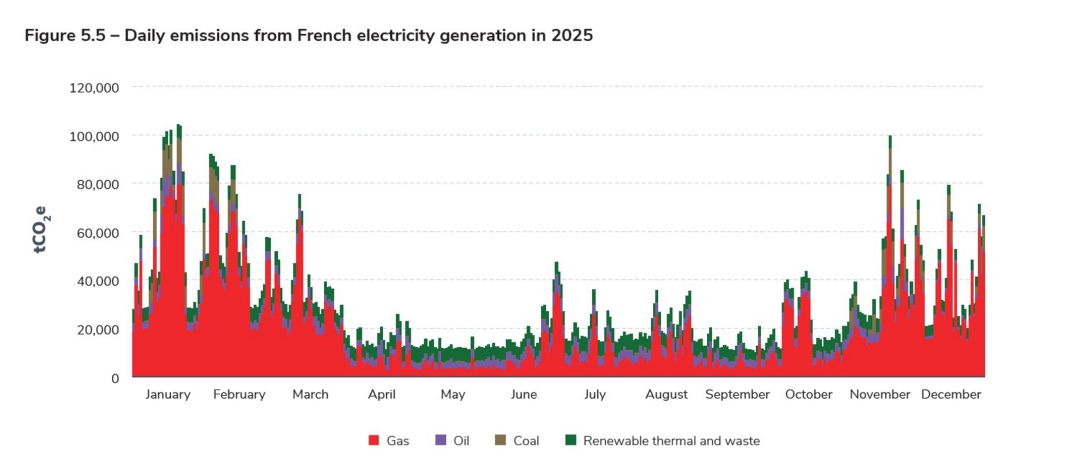
Fossil-fired electricity generation was used particularly infrequently in 2025, which explains these unusually low levels of emissions (see the Generation chapter). In particular, the most emissions-intensive fossil fuels, coal and oil, were scarcely used at all. Gas-fired generation, which currently relies mainly on fossil gas, emits slightly smaller quantities of greenhouse gases than coal and oil. It currently accounts for the bulk of fossil-fired electricity generation in France, and also reached an all-time low in 2025.
With French electricity generation now almost entirely low-carbon, the main challenge for France is to replace fossil fuels with low-carbon electricity on a large scale in sectors other than electricity generation (such as transport, buildings and industry). This will mean an increase in electricity consumption in the medium to long term.
The decarbonisation of the electricity mix has been achieved gradually and successfully over the last few decades, with the development and maintenance of a large base of low-carbon hydroelectric and nuclear generation, followed by the closure of the most polluting power plants (coal and oil-fired) and the development of solar and wind generation. For the French energy system as a whole, two goals must now be pursued at the same time:
- from the consumption viewpoint , making the massive switch from fossil energy vectors to electricity a reality across the economy (transport, industry, tertiary and residential buildings (see the Electrification chapter) and in new energy uses (data centres, electrolysers);
- from the electricity generation viewpoint, establishing a development pathway for low-carbon generation resources that is consistent with the target pathway for decarbonising the economy.
These issues are examined and developed in detail in the 2025–2035 Generation Adequacy Report published by RTE at the end of 2025.
1
Partly because of the higher proportion of electric heating compared with other countries. In 2024, electricity consumption was about 6,600 kWh/capita in France, compared to 6,000 kWh/capita in Germany, 5,900 kWh/capita in the European Union and less than 5,400 kWh/capita in Spain and Italy (source: Eurostat).
2
Sources: CITEPA, Rapport Secten 2025, 2025 ; European Environment Agency; Eurostat; ENTSO-E; calculations by RTE.
3
The gross territorial emissions of the European Union amounted to 3,039 MtCO2e in 2024 (source: European Environmental Agency). Direct emissions due to electricity generation in the European Union reached 519 MtCO2e (source: Ember Climate, Yearly electricity data, 2025).
Section externalisée
Menu tertiaire
Paragraphes de la section
French electricity generation has been largely decarbonised since the late 1980s, and is now almost entirely low-carbon
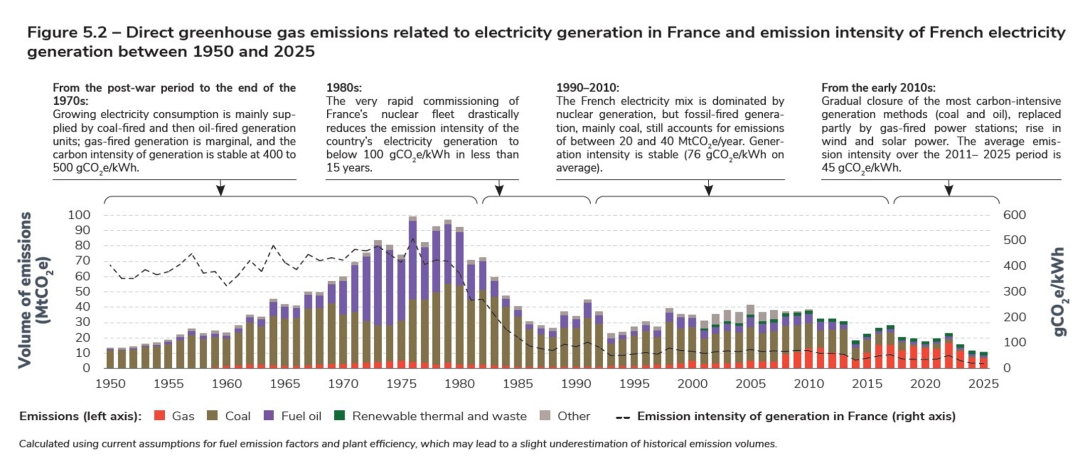
From the beginning of the 20th century, it is possible to identify six major periods for the French power system in terms of greenhouse gas emissions4:
- Before 1945, electricity played a relatively minor role in the country’s energy system. It became more widely used over the first half of the 20th century, particularly for lighting, but there was still no unified transmission grid, and generating facilities were mostly private, for industrial use. The bulk of electricity generation came from coal and hydropower;
- From the post-war period until the end of the 1970s, generation was highly carbon-based; the significant increase in electricity consumption (+1% per year on average), in a context of strong economic growth and the electrification of the country, was mainly covered by hydropower and coal- and oil-fired power plants. The average intensity of electricity generation in France thus remained between 400 and 500 gCO2e/kWh. In 1976, annual emissions related to electricity generation in France reached nearly 100 MtCO2e;
- During the 1980s, the rapid commissioning of the nuclear reactors that make up the current fleet, in parallel with continued growth in national electricity consumption (+0.4% per year on average over the decade), resulted in a very rapid decarbonisation of the French electricity mix5. This deployment saw the fuel-oil fleet almost disappear and emissions related to coal halve between 1980 and 1990. As a result, the carbon intensity of French generation was divided by four in ten years: in 1990, it was less than 100 gCO2e/kWh;
- Between 1990 and the late 2000s, emissions and the emission intensity of generation remained relatively stable. The electricity mix was dominated by nuclear power, but a proportion (between 10 and 20 GW) of the fossil-fuel thermal plants, particularly coal-fired, were still in operation. Greenhouse gas emissions (between 20 and 40 MtCO2e) and carbon intensity (around 75 gCO2e/kWh) remained stable over the period;
- From the early 2010s until the start of the energy crisis in 2022, the oil- and coal-fired generating fleet was gradually scaled back, driven by stricter targets for reducing greenhouse gases and pollutant emissions. Some of this production capacity has been replaced by gas-fired power stations, which emit less for the same amount of energy produced. The 2010s were also marked by strong growth in wind and solar power. All these factors together contributed to further reducing the intensity of French electricity generation, which reached 47 gCO2e/kWh on average over the period 2010–2023. At the end of this period, it can now be said that the French electrical system has virtually completed its decarbonisation process. The energy crisis of 2022, which led to a one-off rise in emissions that was absorbed the following year, did not significantly alter this trend;
- In the wake of the energy crisis, the French power system is entering the next phase of its transformation: providing leverage for the decarbonisation of the economy as a whole. In this new phase, we are no longer talking about decarbonising electricity, but all energy consumption in France. This will require a massive increase in the use of electricity in all sectors, accompanied by the development of low-carbon electricity generation infrastructure capable of supporting the increase in consumption. As the analyses in the various chapters of the Electricity Review and the latest Generation Adequacy Report show, this phase has yet to achieve real momentum: the stagnation in electricity's share of final energy consumption highlights the delay in electrification. The abundance of low-carbon electricity generation, on the other hand, presents a real opportunity to accelerate the electrification of the French power system.
4
The emission factors of the different generation sources used to calculate the emissions over the entire period 1950–2025 are the current emission factors (see Appendix). Strictly speaking, it should be taken into account that emission factors tend to decrease (very slowly) over time with improvements in plant efficiency, changes in the quality of fossil fuels, etc. However, the approximation made here is not likely to substantially modify the results of
the analysis.
5
The main objective at the time was the improvement of energy sovereignty and not the decarbonisation of the mix.
Section externalisée
Menu tertiaire
Paragraphes de la section
Sustained low emissions reflect a new era for electricity generation in France
In 2022, the crisis in electricity generation in France led to a real but limited increase in emissions from the French power system (see the Emissions chapter of the 2022 Electricity Review). This one-off cyclical episode did little to alter the broader dynamic of deep and gradual decarbonisation that has taken shape over the last ten years.
Emissions quickly returned to a particularly low level: between 2022 and 2023, generating emissions fell by almost a third to 15.8 MtCO2e, their lowest level since 1953. This drop was mainly due to the upturn in low-carbon generation, and particularly the recovery in nuclear power. The downward trend then continued: in 2024 emissions reached 11.7 MtCO2e, and in 2025 they stood at 10.9 MtCO2e. This is once again a historically low level, comparable to the early 1930s, when the volume of electricity generation, entirely coal-fired, was almost 30 times lower than today.
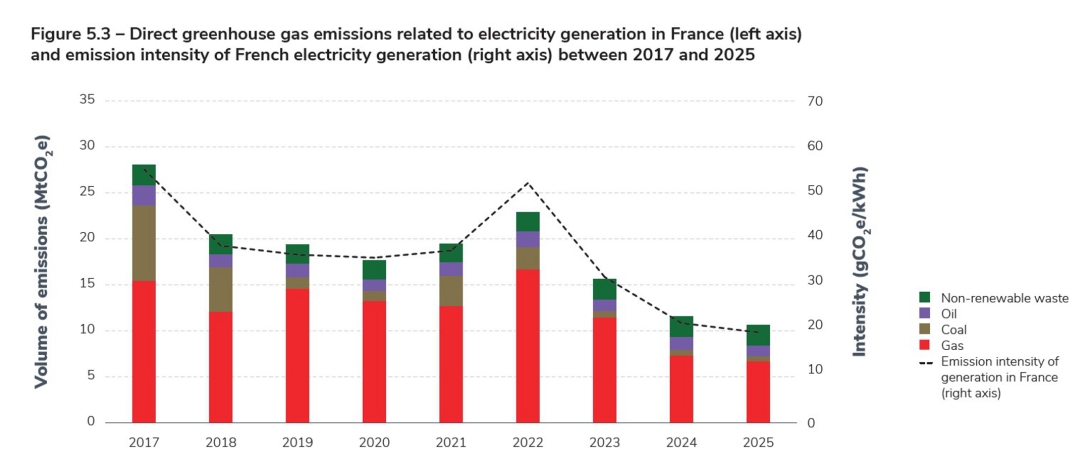
Just under two-thirds (6.7 MtCO2e) of generation-related emissions come from gas as a generating source. Of these, almost 40% (3.2 MtCO2e) are associated with production facilities that fall into the cogeneration category, i.e. facilities that mainly produce heat to supply industrial processes or district heating networks, with electricity as a by-product. They operate regardless of conditions in the electricity market, and correspond to a “base” level of generation and emissions (see the Generation chapter) that cannot easily be reduced. Electricity generation from the incineration of non-renewable waste, which is also mainly determined by the need to deal with waste, independently of conditions on the electricity market, accounts for around one-fifth of the volume of emissions, or 2.3 MtCO2e.
The proportion of emissions that cannot be attributed to cogeneration or inflexible sectors thus represents only 40% of the emissions linked to electricity generation. This proportion corresponds to generation resources that help to balance the system during periods of high consumption, with relatively short operating times. These “residual” emissions from the French mix should be seen, at least in the short term, as enabling the system to function properly and the low-carbon generating fleet to develop: they represent a low volume of emissions compared to the service they provide to the system.
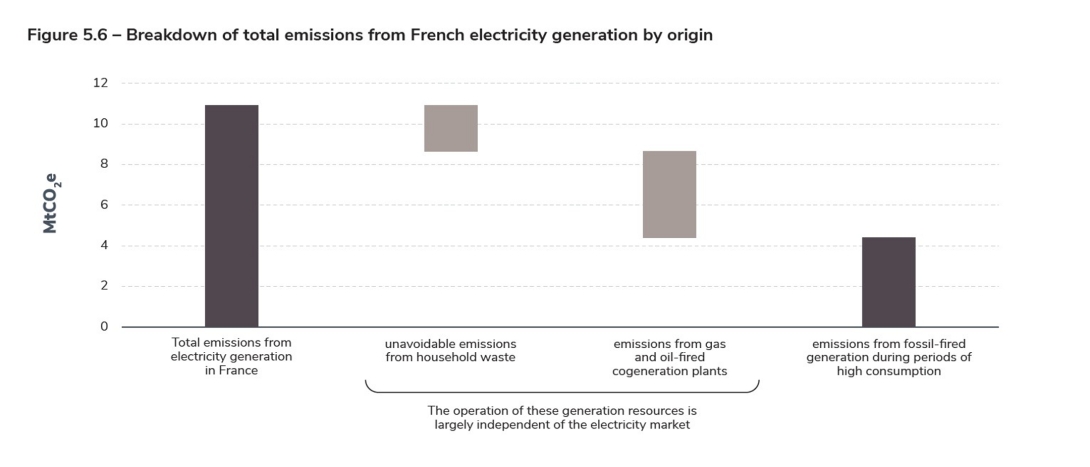
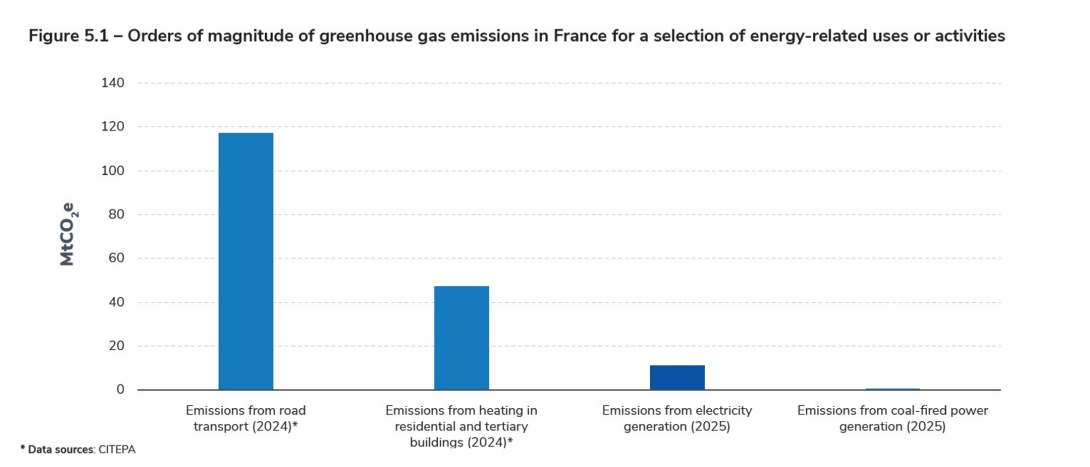
Coal is hardly used at all, except during periods of high consumption: it generated less than 0.6 MtCO2e over the year as a whole, which is roughly the equivalent of one day's road transport emissions in France. It is interesting to note that the total emissions from electricity generation are equivalent to around three weeks of road transport emissions (see Figure 5.1 above).
On an hourly basis, the carbon intensity of the French power system remained limited throughout the year
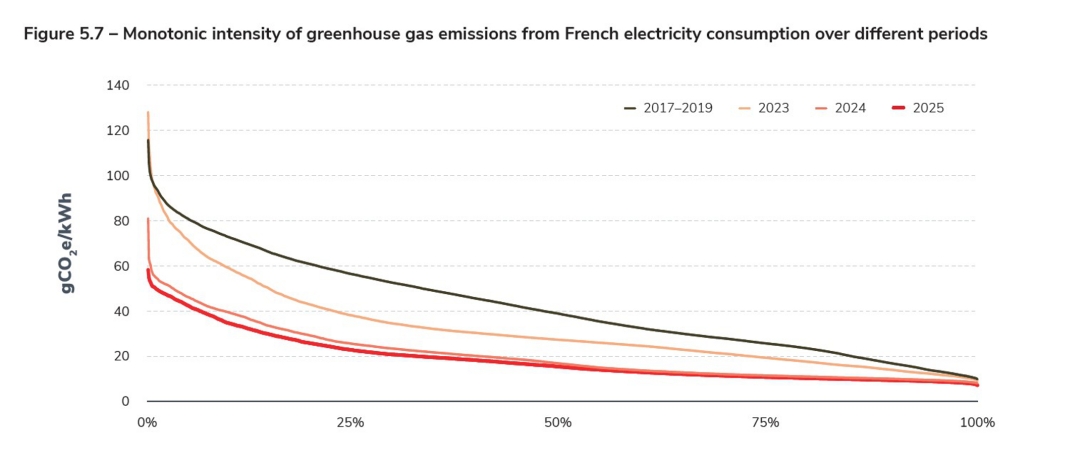
On average over 2025, the carbon intensity of French electricity generation was 19.6 gCO2e/kWh, and the carbon intensity of French consumption, taking electricity trading with other countries into account, was 20.0 gCO2e/kWh. The fact that these two values are almost identical can be explained by France being almost exclusively a major net exporter over the year (see the Trading chapter).
The intensity of both generation and consumption was below 15 gCO2e/kWh almost half the time. This practically irreducible level, which can be seen as the system's “background intensity”, corresponds to emissions from sources that are largely inflexible from the point of view of the power system (see the analysis in the previous section), i.e. waste incineration and cogeneration.
Even in a low-carbon power system, there are likely to be occasional spikes in the intensity of generation and consumption. These occur mainly in winter, during periods of high consumption, when it is necessary to call on fossil-fired thermal generation and possibly imports from countries whose power is more carbon-intensive. In 2023, for example, the carbon intensity of consumption exceeded 100 gCO2e/kWh around 3% of the time.
In 2025, this intensity remained limited even during periods of high consumption, reaching a maximum of 58 gCO2e/kWh. This is a very low level, below the average intensity of French production over the whole of 2012.
Even taking life-cycle emissions into account, emissions related to the French power system remain very low
The carbon intensity related to electricity generation can be calculated by considering only direct emissions, as in the previous paragraphs, or by including all emissions related to electricity generation over the life cycle. As well as the direct emissions related to combustion in power plants (for fossil fuel-fired power plants), this second approach includes all the emissions related to the life cycle of generating facilities: from the extraction and transport of fuels and raw materials or equipment to the construction of infrastructure allowing the generation of a given amount of energy. Some generation sources, such as wind, solar and hydropower, do not cause direct emissions, but the construction of dams, the manufacture and transport of solar panels and wind turbines and their installation generate indirect emissions that are taken into account in this approach.
In 2025, the emissions attributable to French electricity generation in terms of life cycle analysis were 15.7 MtCO2e, very close to the total recorded in 2024 (16.2 MtCO2e). Life cycle analysis leads to the same conclusion as analysing direct emissions: the emissions from electricity generation in France are among the lowest in Europe. The intensity of generation reached 29.0 gCO2e/kWh across the life cycle.
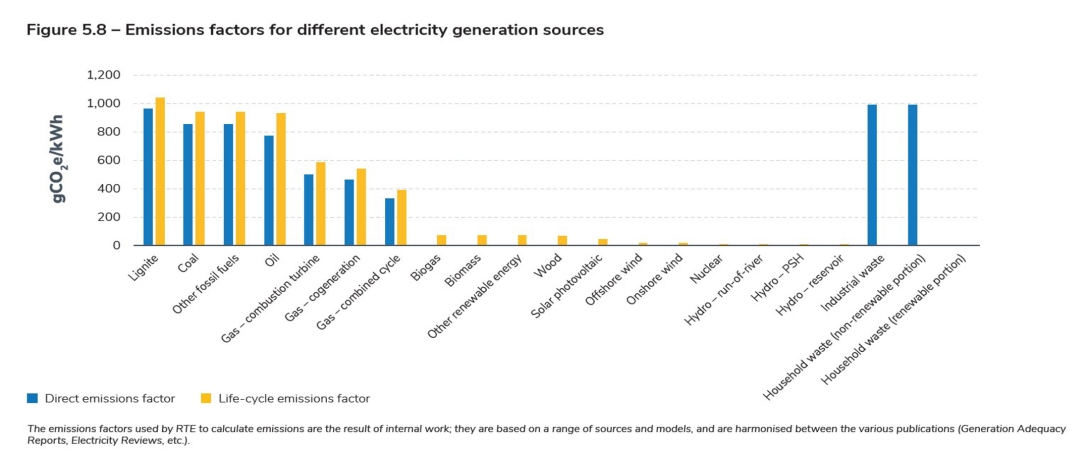
Greenhouse gas emissions over the life cycle of low-carbon energy sources remain very low compared to those of fossil-fuel thermal facilities: 16 gCO2e/kWh for onshore wind power, 17 gCO2e/kWh for offshore wind power, 43 gCO2e/kWh for photovoltaic solar power, 7 gCO2e/kWh for nuclear power and 6 gCO2e/kWh for hydropower, compared to 941 gCO2e/kWh for coal-fired power plants, 928 gCO2e/kWh for oil-fired power plants and 389 gCO2e/kWh for combined cycle gas power plants, which are the most efficient gas-fired power plants.
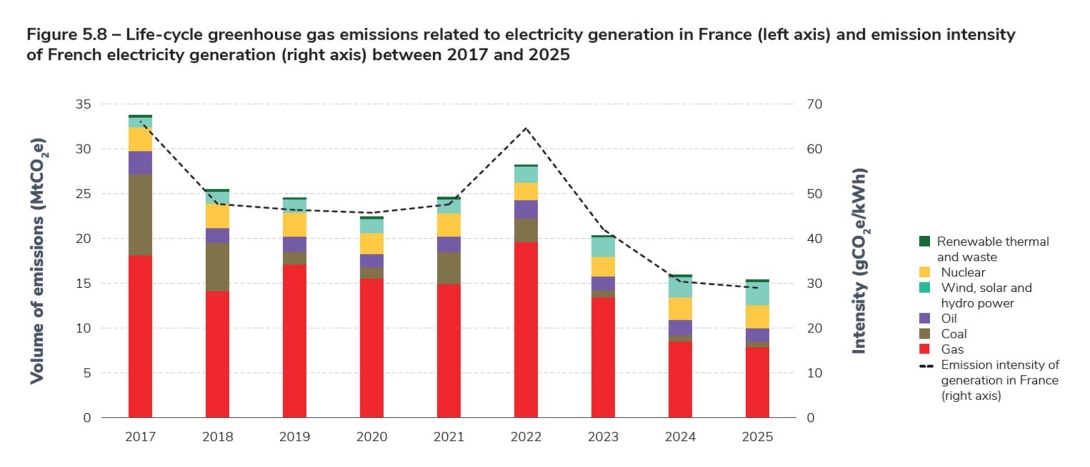
As the share of fossil-fired generation in the production mix decreases, the proportion of emissions linked to direct emissions from combustion decreases, and the share of emissions linked to the rest of the life cycle of the generating plants automatically increases. That being the case, despite their now-significant share of the electricity mix, the combined contribution of wind, solar and hydropower to life-cycle emissions from electricity generation remains very low. In 2025, these sources accounted for around 16% of total life-cycle emissions from electricity generation in France (i.e. 2.6 MtCO2e), while contributing around 25% to the country's electricity mix. Fossil-fired sectors, by contrast, made up less than 4% of the national generation mix, but accounted for 63% of life-cycle emissions from electricity generation. Furthermore, when looking at the wider scope of the country's carbon footprint6, the emissions associated with these three renewable generation sources represent less than 0.5% of the total.
6
The carbon footprint refers to all emissions, both domestic and foreign, that are attributable to the national consumption of a given country. This therefore counts emissions generated abroad by the production of goods or services consumed in the country in question, but not emissions generated in the country in question by the production of goods or services that are consumed abroad. It is a concept close to the life cycle, but distinct: the carbon footprint is based on the attribution of emissions to the consumption of a given territory, while the life cycle analysis is based on the attribution of emissions to a given energy use, activity or object. The proportion of the carbon footprint made up of life-cycle emissions from renewable power is given here as a guide based on the total 2024 footprint, as the value of the footprint for 2025 is not yet known.
Section externalisée
Menu tertiaire
Paragraphes de la section
French low-carbon electricity exports are an asset for the European power system
As French electricity generation is already almost entirely low-carbon, the country’s electricity exports, which reached a record level in 2025 (92.3 TWh, see the Trading chapter), are helping to avoid emissions elsewhere in Europe. Exports of electricity to other countries make it possible to limit fossil-fired generation, particularly from coal and gas, in neighbouring countries.
To evaluate these avoided emissions, we can compare the intensity of French generation with that of the countries to which the electricity is exported, for each hour. The emissions avoided thus depend on the carbon intensity differential between the generation mixes of France and the other countries on one hand, and on the quantity of electricity exported on the other. This approach necessarily involves simplifications, and omits certain phenomena specific to the operation of the power system: in particular, it does not account for the effect that a change in trade would have on the order of economic precedence in each country. That said, an analysis of the avoided emissions calculated in this way does reveal trends, particularly in terms of time and geographical distribution.
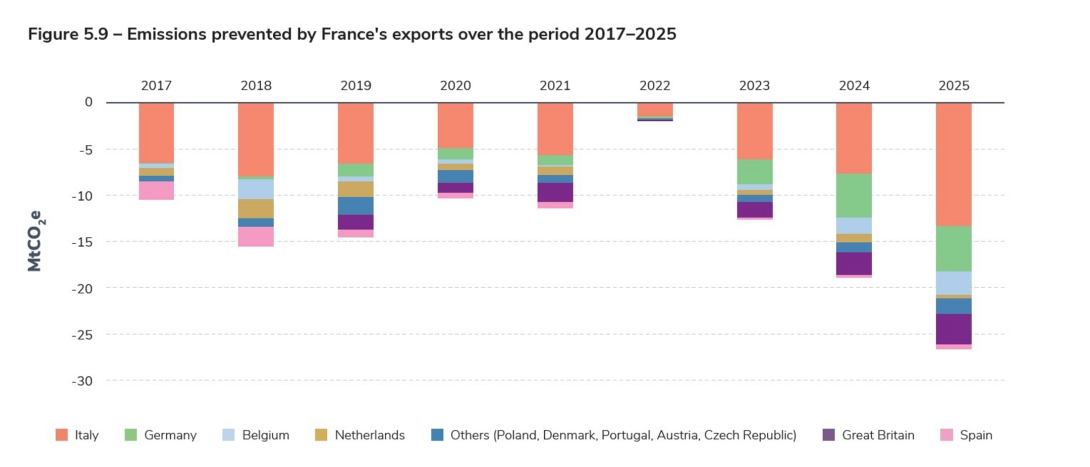
In 2025, exports from France prevented the emission of almost 27 MtCO2e in Europe, nearly half of it in Italy and a fifth in Germany. This is a record level, driven on one hand by the slight increase in the export balance, and on the other by the different distribution of exports: specifically, the proportion of exports to Italy, a country with one of the largest carbon intensity differentials, was higher in 2025, while exports to Spain, whose mix is mostly low-carbon, fell (see the Trading chapter). More broadly, the increase in the export balance over the last two years has offset the effect of the gradual decarbonisation of power generation elsewhere in Europe (see the Europe chapter), and therefore the fall in the carbon intensity differential between France and other countries.
Emissions from electricity imports are virtually zero
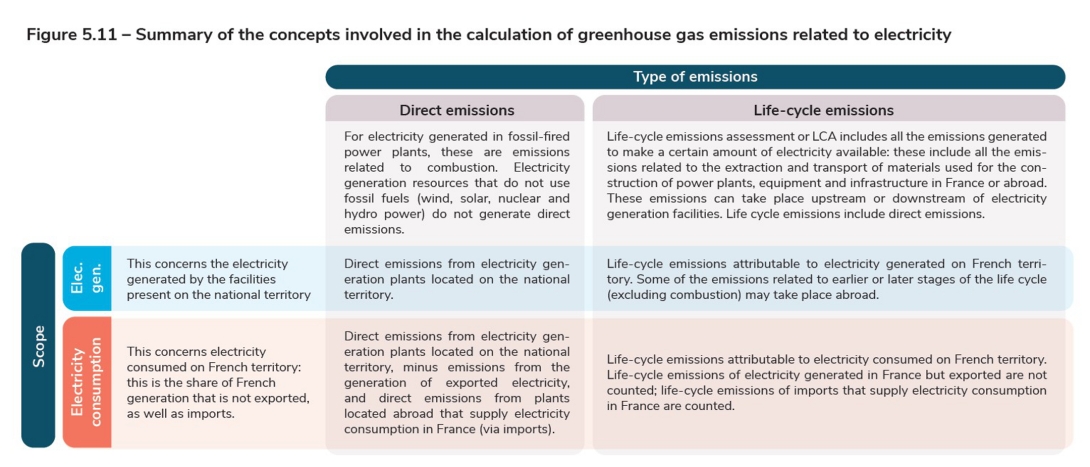
Emissions linked to the French power system can be assessed in relation to different scopes (see Figure 5.11): the electricity generated in France, detailed in the previous sections, but also the electricity consumed in France. As well as the proportion that covers the country’s own consumption, part of the electricity produced in France is exported to other European countries. Conversely, part of France's consumption is covered by imports of electricity generated abroad, particularly during high-consumption periods in winter, or when it is cheaper to import from neighbouring countries (particularly if there is abundant renewable generation in those countries) than to start up more expensive generating facilities in France.
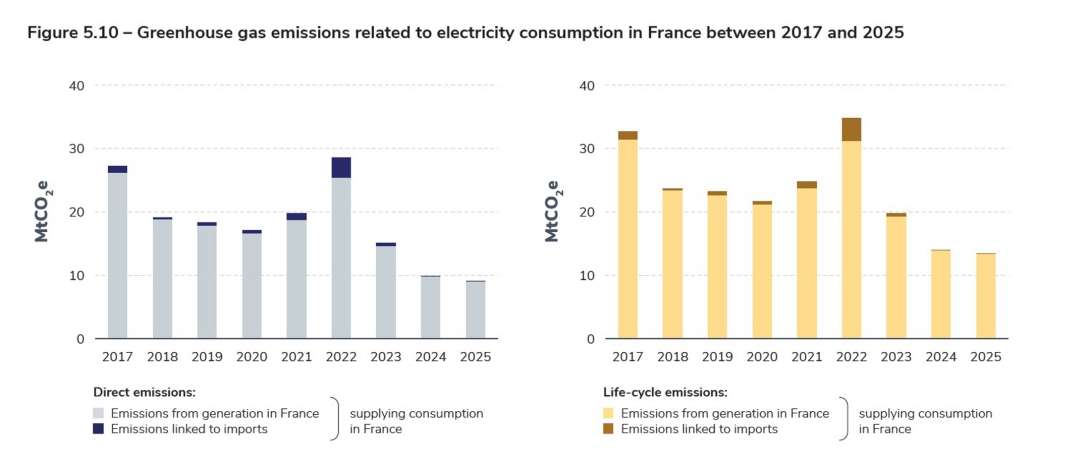
In 2025, the emissions arising from electricity imports that were actually used to supply French consumption were close to zero. This is a direct consequence of the fact that the country was a net exporter almost 99% of the time.
In addition, we estimate that around 17% of emissions from electricity generation in France were associated with volumes of electricity that were exported. Emissions linked strictly to French electricity consumption amounted to 9.1 MtCO2e (see Figure 5.1 above for a comparison of the orders of magnitude).